








In 2024, the median spend on a major kitchen remodel in the United States hit roughly $80,000, underscoring how costly many of the most popular kitchen remodeling trends 2024 are becoming. That raised fresh questions about kitchen renovation ROI, according to Remodeling Magazine’s annual Cost vs. Value report. Value report. And yet, homeowners typically recoup only about 30–40% of that at resale. That gap—between what people pour into kitchens and what they get back—has quietly reshaped how designers, contractors, and homeowners approach the room that used to be a status symbol.
The modern kitchen isn’t about showing off. It’s about working better.
Why “Open Concept” Isn’t the Default Anymore
For two decades, knocking down walls felt like progress. HGTV practically made it doctrine. But lately, there’s a noticeable shift.
Architects like Sarah Susanka, known for her “Not So Big House” philosophy, have long argued that defined spaces create calmer, more functional homes. Now the market is catching up. According to a 2023 Houzz Kitchen Trends Study, only about 43% of renovating homeowners chose a fully open layout. That was down from a majority just a few years earlier.
The Rise of the “Broken Plan”
Instead of one giant room, designers are carving out partial divisions—glass partitions, half-walls, or changes in ceiling height. It’s subtle. You still get light and flow, but also noise control and visual boundaries.
For example, British designer Laura Hammett has made steel-framed interior glazing popular in London remodels. It separates the kitchen from living areas without sacrificing daylight. And it turns out that matters more than people expected. That is especially true in households where someone is always on a video call.
Kitchens That Can Close Themselves Off
There’s also a practical reality: cooking smells, clutter, and sound. For example, sliding pocket doors are making a comeback in urban apartments. In New York, firms like Workshop/APD have been reintroducing concealed doors that allow kitchens to disappear when needed.
It’s not nostalgia. It’s fatigue with mess being permanently on display.
Cabinets Are Eating the Kitchen
If you walk into a newly remodeled kitchen today, you might notice something missing: stuff. Or at least, visible stuff.
That’s not minimalism for its own sake. It’s storage engineering.
The Shift to Full-Height Cabinetry
Floor-to-ceiling cabinets are now standard in higher-end remodels. IKEA’s SEKTION system made this look accessible. But custom shops have gone further with integrated panels that hide everything from refrigerators to coffee stations.
According to the National Kitchen & Bath Association (NKBA) 2025 Design Trends report, more than 70% of designers said “concealed storage” was a top client request. Not open shelving. Not glass-front displays. Concealment.
And it makes sense. Open shelves photograph well, but they demand constant styling. Real kitchens accumulate things.
Inside the Drawer Revolution
This is where the money often goes quietly. German hardware manufacturer Blum, for instance, has built an entire business on soft-close hinges and modular drawer inserts. Their Legrabox system allows for deep drawers that replace lower cabinets entirely.
It’s a small ergonomic shift with outsized impact. Pull-out drawers reduce bending and make inventory visible at a glance. You don’t buy three jars of cumin because you forgot the first two existed. (I’ve done this. More than once.)
Countertops: The Quartz Takeover
Granite had a long run. Marble still carries prestige. But engineered quartz now dominates the market.
Caesarstone and Silestone helped push quartz to roughly 45–50% of countertop installations in the U.S. The reasons are practical: non-porous surfaces, consistent patterns, and lower maintenance.
The Backlash Against “Perfect”
But something interesting is happening. Designers are starting to push back against ultra-uniform surfaces.
Natural stone—especially quartzite—is creeping back into high-end projects. Unlike marble, quartzite offers durability with more variation. Firms like Studio McGee have leaned into this look, favoring slabs with visible veining and imperfections.
There’s a broader aesthetic shift here. Kitchens are getting warmer, less clinical. The all-white, high-gloss look is fading.
Mixing Materials, Carefully
Another emerging approach is combining countertop materials within the same kitchen. For example, a durable quartz perimeter with a statement marble island.
It sounds indulgent, but it can be strategic. You place the high-maintenance material where it sees less wear. The data on longevity is thin. Still, contractors report fewer staining-related service calls when homeowners take this hybrid approach.
Appliances Are Getting Smarter—and Quieter
Walk into a showroom and you’ll see screens everywhere: refrigerators with Wi-Fi, ovens you can preheat from your phone, faucets that respond to voice commands.
The question is whether any of this actually improves daily life.
Induction Is Finally Going Mainstream
Induction cooktops, long popular in Europe, are gaining traction in North America. Brands like Bosch, GE Profile, and Miele have expanded their offerings significantly since 2022.
The U.S. Department of Energy notes that induction is about 85–90% energy efficient, compared to roughly 32% for gas. That’s not a marginal gain.
And there’s a safety argument. It means no open flame, faster cooling, and better indoor air quality. Researchers at Stanford linked that to lower exposure to nitrogen dioxide from gas stoves.
The Quiet Kitchen
Noise used to be an afterthought. Not anymore.
Dishwashers from brands like Bosch and KitchenAid now operate as low as 38–44 decibels. That’s library-level quiet. Vent hoods are also improving, though performance varies widely depending on installation.
This matters because kitchens are no longer isolated workspaces. They’re shared environments—for working, talking, existing. A loud appliance can dominate a room in a way people didn’t mind in 1995 but won’t tolerate now.
Lighting: The Most Underrated Upgrade
People obsess over countertops and cabinet finishes, then install a single overhead fixture and call it done.
It’s a mistake.
Layered Lighting Done Right
Good kitchen lighting has at least three layers: ambient, task, and accent. This isn’t design-school theory; it’s practical.
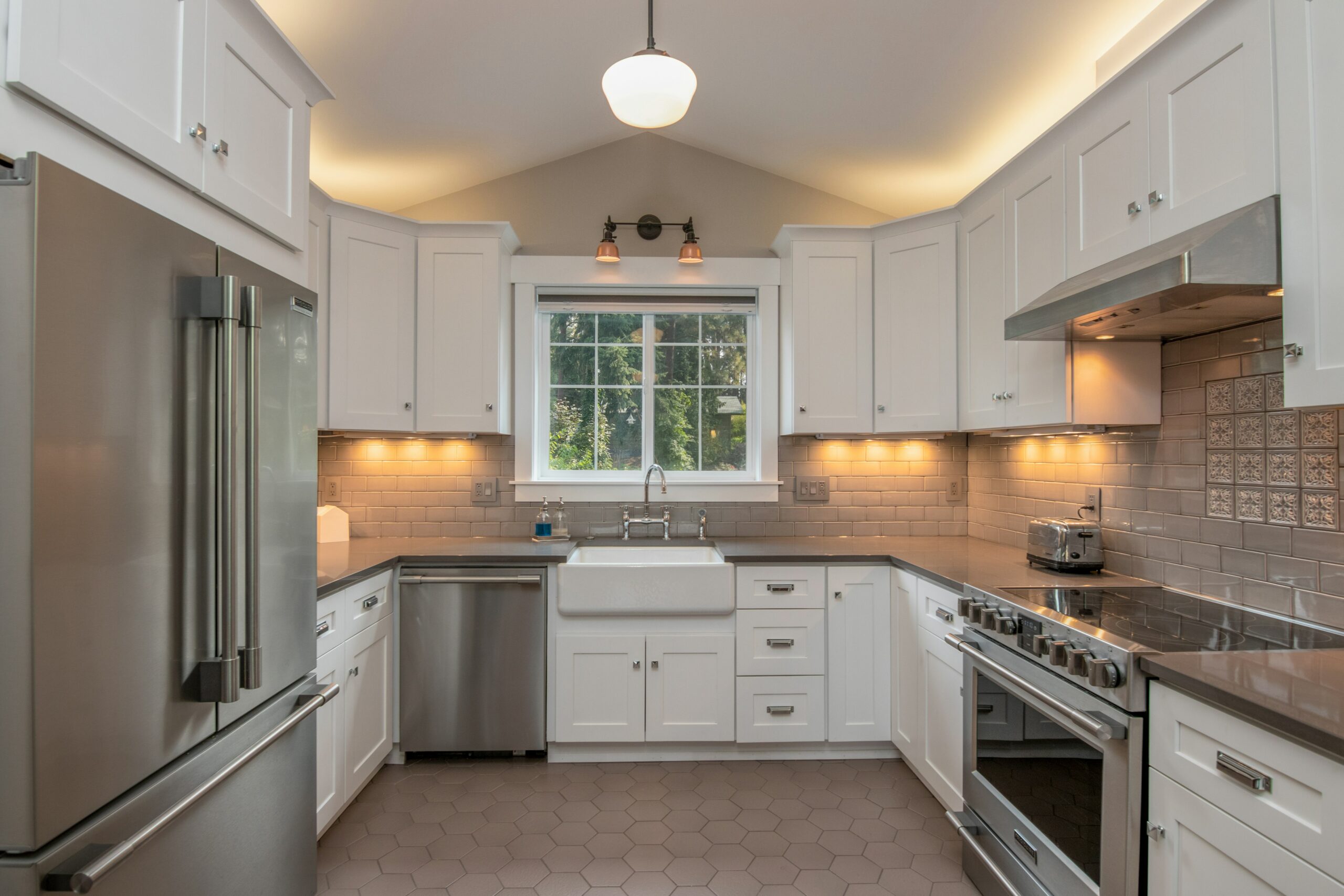
Under-cabinet LED strips, for instance, dramatically improve visibility on work surfaces. For example, companies like Häfele and Philips Hue offer systems that can shift from cool light during food prep to warmer tones in the evening.
The Illuminating Engineering Society recommends around 300–500 lux for kitchen task areas. Most poorly lit kitchens fall far below that.
The Case for Fewer Pendants
Pendant lights over islands became a default choice. Now some designers are pulling back.
Why? Sightlines. Visual clutter. Maintenance.
In smaller kitchens especially, recessed lighting combined with a single statement fixture can feel cleaner. It’s not anti-style—it’s restraint.
What Actually Adds Value (and What Doesn’t)
There’s a persistent myth that any kitchen upgrade pays for itself. The numbers say otherwise.
According to Remodeling Magazine’s 2024 report, a minor kitchen remodel (around $27,000) recoups roughly 70–80% of its cost at resale. A major upscale remodel? Closer to 30%.
That gap should change how people think about priorities.
Start with layout. Spend on storage. Spend on lighting. These are hard to retrofit later and directly affect daily use.
Be cautious with hyper-specific choices. A built-in espresso machine might delight you and confuse a future buyer. The same goes for bold color schemes or highly customized cabinetry.
Real estate agent Jessica Lautz says buyers consistently rank “updated, functional kitchens” as a top priority. But they rarely pay extra for luxury features beyond a certain point.
There’s a ceiling. And many remodels crash into it.
The Kitchen as a Working Room Again
For a while, kitchens drifted toward being showpieces. Big islands, dramatic finishes, just enough functionality to justify the aesthetic.
That era isn’t entirely over. But it’s softening.
The pandemic years forced people to actually use their kitchens—multiple times a day, often simultaneously. That experience seems to have stuck. Designs now reflect friction points people can’t ignore: where things pile up, where movement gets blocked, where lighting fails at 6 p.m. in winter.
There’s something almost old-fashioned about this shift. The kitchen, reconsidered as a place to work.
And maybe that’s the quiet correction after years of excess: not smaller ambitions, but sharper ones.